

dailysylheter somoy
January 24, 2024
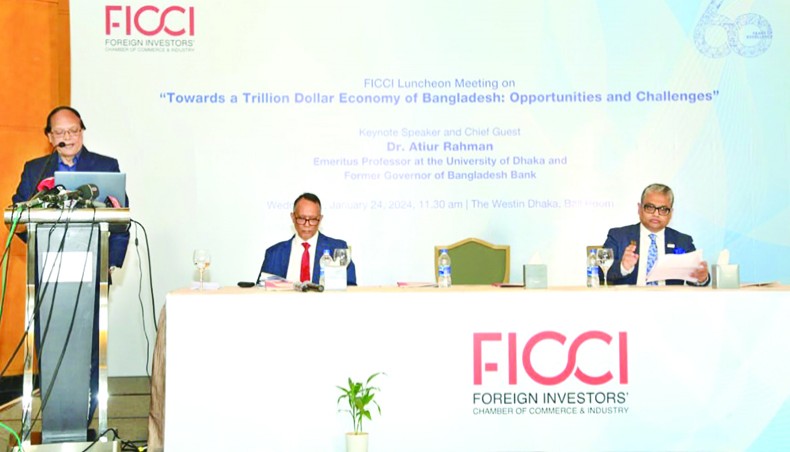
News Desk :: Former Bangladesh Bank governor Atiur Rahman on Wednesday said that Bangladesh’s average foreign direct investment inflow (as percentage of gross domestic product) between 2010 and 2022 stood at 0.9, significantly lower than India’s 1.7 and Vietnam’s 4.6.
He termed inadequate trade logistics and infrastructure, complex investment policy and business regulations, low productivity, lack of depth in the financial sector and unfavourable tax environment the factors hindering FDI in Bangladesh.
Atiur stressed the critical importance of boosting FDI for unlocking Bangladesh’s macroeconomic potential and achieving stability in its financial account balance, foreign exchange market and inflation control.
He made the statements at a programme organised by the Foreign Investors’ Chamber of Commerce and Industry at The Westin Hotel in the capital Dhaka on the day.
The event aimed to engage leaders on Bangladesh’s investment, trade and commerce opportunities.
The economist also underscored the impact of rising balance of payment deficits and depleting reserves, emphasising the role of robust FDI in managing these challenges.
He also noted that the devaluation of the local currency contributed to high inflation by increasing import costs, suggesting that increased FDI could help stabilise the currency.
Related Coverage:
› Unease of doing business slows FDI inflow in Bangladesh
› Corruption, complexities in getting permission blocking FDI: CPD
Atiur outlined several key areas for the government to address, including reducing dominance of unofficial channels like ‘hundi’ for remittance transfers, improving financial sector governance, rationalising public sector spending and enhancing revenue collection.
He highlighted the need for affordable and reliable access to power and fuel to facilitate investments.
In his keynote presentation titled ‘Towards a Trillion Dollar Economy of Bangladesh: Opportunities and Challenges,’ Atiur projected that Bangladesh could achieve a trillion-dollar economy by 2040 with a 5-per cent growth rate, and even sooner by 2030 with a double-digit growth rate.
He attributed Bangladesh’s success to its multidimensional approach to sustainable development.
FICCI president Zaved Akhtar echoed Atiur’s views, emphasising the need for focusing on opportunities rather than challenges.
The event was attended by FICCI advisers, board members, CEOs of member companies, representatives of various embassies and other stakeholders.


News Desk :: Students from Dhaka College and City College once again clashed in the capital’s Science Lab area on

News Desk :: TIn southern Morocco, volunteers are hunting for waste embedded in the sand, and they don’t have to

News Desk :: The third round of talks between the BNP delegation and the National Consensus Commission is currently taking
News Desk :: Bangladesh Ambassador to Qatar Md Nazrul Islam received Prof Yunus upon his arrival at Hamad International Airport

News Desk ::In yet another price hike within just two days, the Bangladesh Jewellers Association (BAJUS) has announced a new

He claims that false and conspiratorial propaganda is being carried out against Rahima Khanam, a UK expatriate daughter of Maulana

News Desk :: The suspect, identified as Mozammel Hossain, a CNG-run autorickshaw driver from Gorai-Sakhipur road, is the son of

News Desk :: In a major policy shift, Russia’s Supreme Court on Thursday officially removed the Taliban from its list


