

Daily Sylheter Somoy
December 21, 2020
Online Desk
With the COVID-19 pandemic being the latest crisis facing the world, a new report published globally by the United Nations Development Programme (UNDP) warns that unless humans release their grip on nature, it won’t be the last.
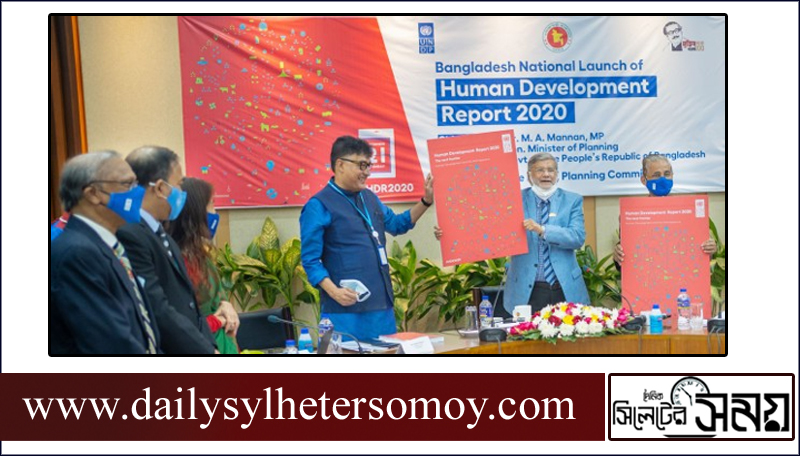
The Human Development Report (HDR) 2020 titled, The Next Frontier: Human Development and the Anthropocene, launched in Bangladesh on December 21, 2020, six days after the global launch, includes a new experimental index on human progress, said the UNDP on Monday.
The 30th Anniversary Edition of the report, the HDI, which usually measures a nation’s health, education, and living standards, has been adjusted to include two more elements: a country’s carbon dioxide emissions and its material footprint.
The adjustment now shows how the global development landscape would change if both the wellbeing of people and the planet were central to defining humanity’s progress.
For example, more than 50 countries dropped out of the very high human development group, reflecting their dependence on fossil fuels and material footprint.
“As this report shows, no country in the world has yet achieved very high human development without putting immense strain on the planet. But we could be the first generation to right this wrong. That is the next frontier for human development,” said Achim Steiner, UNDP Administrator, during the global launch
On the other hand, Bangladesh moved up two notches in the traditional HDI to 133 compared to last year.
However, it remains fifth among the eight south Asian countries covered in the report but bounced up nine notches in the new planetary pressures-adjusted human development index (PHDI).
“Despite numerous challenges, Bangladesh is committed to nourishing the health of our planet, and working towards building a “Shonar Bangla,” as envisioned by the Father of our Nation,” said Planning Minister MA Mannan, who unveiled the report in Bangladesh.
“The strain on our planet mirrors the strain facing many of our societies. Climate change, among other dangerous planetary changes, will only make them worse,” he also added.
UNDP Bangladesh’s Resident Representative, Sudipto Mukerjee, pointed out that the Coronavirus pandemic’s collateral costs far outweigh the loss of lives.
“To name a few of the obvious, such as a large number of people pushed into poverty due to lost livelihoods, increased inequalities, increased gender-based violence, increased risks of having a large proportion of children and youth dropping out of education, etc.,” Sudipto pointed out.
“Scientists have been warning of a pandemic like this for years, as a reflection of the pressures people put on Planet Earth,” he continued.
“HDR 2020 points out that our future is not about choosing between people or trees. It’s about choosing to do things differently.”
“Choices that could stop the pandemic and end poverty, close the digital divide, and tackle the climate emergency so that we use this unique moment in time to move to the next frontier for people and planet,” he said, calling for increased cooperation for a better future.
The launch included a presentation detailing on the new PHDI by Balazs Hovarth, Senior Economic Advisor, UNDP Asia Pacific.
Following the launching, a panel discussion was held participated by Prof. Shamsul Alam, Senior Secretary, GED, Planning Commission; Prof. Saleemul Huq, Climate Scientist, Director ICCAD; Dr Fahmida Khatun, Executive Director, Centre for Policy Dialogue; Dr Samia Huq, Anthropologist, Dean of General Studies, BRAC University; and Ar. Iqbal Habib, Architect and Environmentalist. Mr Shahidul Haque, Former Senior Secretary, Foreign Affairs, moderated the discussion.
The report states that Bangladesh has made impressive strides in human development. Between 1990 and 2019, Bangladesh’s HDI value has increased by 60.4 percent.
Bangladesh’s 2019 HDI is above the average for countries in the medium human development group.
Between 1990-2019, Bangladesh’s life expectancy at birth increased by 14.4 years, mean years of schooling increased by 3.4 years, and expected years of schooling increased by 6.0 years. Bangladesh’s GNI per capita also increased by about 220.1 percent between 1990 and 2019.


News Desk :: Students from Dhaka College and City College once again clashed in the capital’s Science Lab area on
News Desk :: TIn southern Morocco, volunteers are hunting for waste embedded in the sand, and they don’t have to

News Desk :: The third round of talks between the BNP delegation and the National Consensus Commission is currently taking
News Desk :: Bangladesh Ambassador to Qatar Md Nazrul Islam received Prof Yunus upon his arrival at Hamad International Airport

News Desk ::In yet another price hike within just two days, the Bangladesh Jewellers Association (BAJUS) has announced a new

He claims that false and conspiratorial propaganda is being carried out against Rahima Khanam, a UK expatriate daughter of Maulana

News Desk :: The suspect, identified as Mozammel Hossain, a CNG-run autorickshaw driver from Gorai-Sakhipur road, is the son of

News Desk :: In a major policy shift, Russia’s Supreme Court on Thursday officially removed the Taliban from its list


